








Introduction
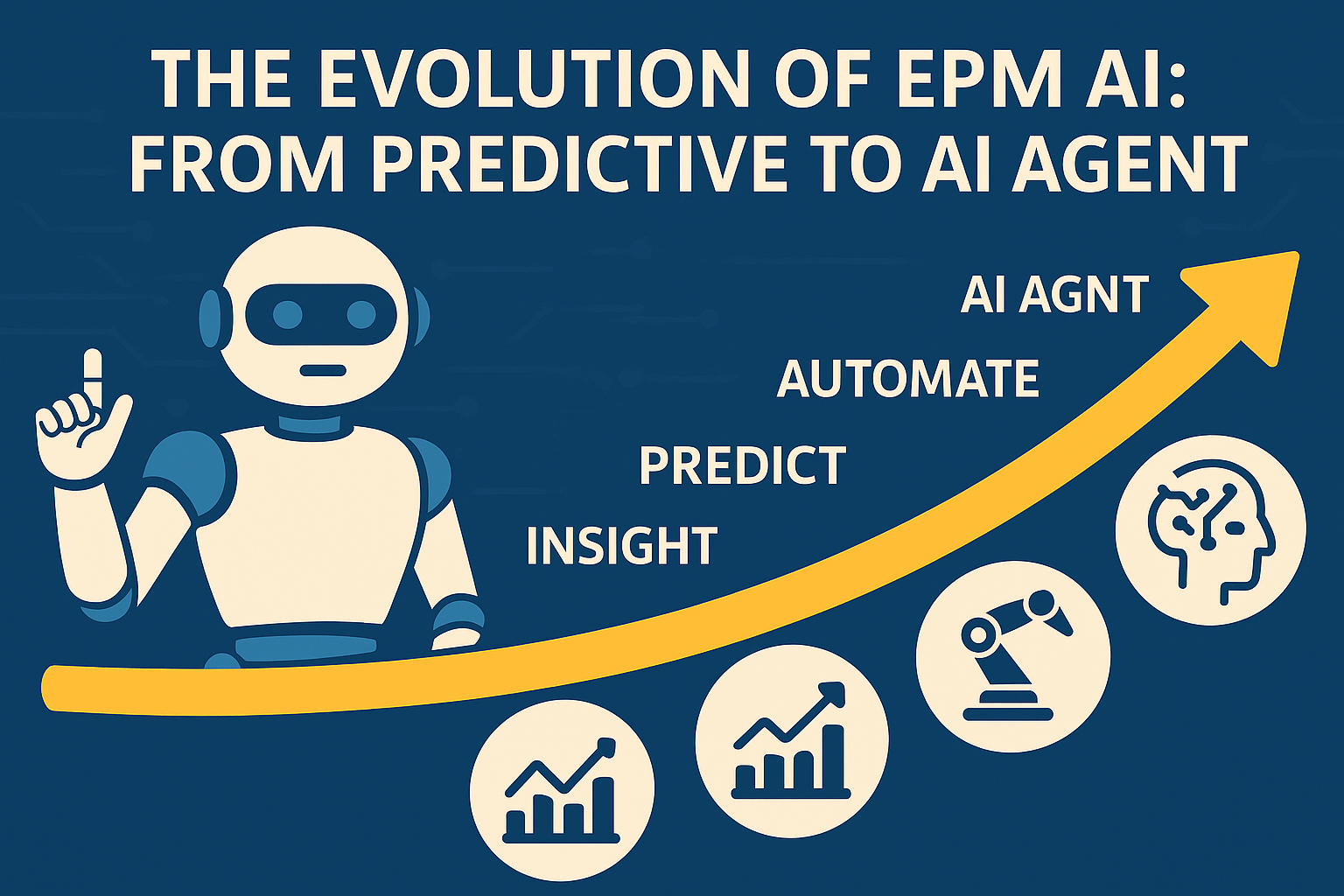
Over the past decade, Oracle EPM has quietly transformed from a traditional planning and consolidation platform into an intelligent, AI-augmented decision engine. What started with Predictive Planning in 2016 has evolved into a comprehensive AI ecosystem, powered by Intelligent Performance Management (IPM), Generative AI (GenAI) and AI Agents, now seamlessly embedded across the EPM Cloud suite.
1. Oracle EPM: AI-Embedded Finance
Oracle’s strategic direction for EPM AI is clear: AI everywhere, built-in, and context-aware. Instead of being a separate add-on or external model, AI capabilities are embedded directly into EPM business processes, including Planning, Narrative Reporting, Account Reconciliation, PCM, and more.
Powered by OCI AI infrastructure and leading large language models (LLMs), Oracle EPM brings trusted, explainable, and finance-grade AI to every layer, data, process, and user experience.
At a high level, Oracle’s AI stack can be summarized as follows and the innovation continues to evolve.
- Dec 2016: Predictive Planning
- Aug 2020: Auto Predict
- Nov 2021: IPM Insights
- Nov 2021: Bring your own ML
- Apr 2024: Predictive Cash Forecasting
- Oct 2024: Generative AI for Management Reporting Narratives
- Apr 2025: Generative AI in Insights
- May 2025: Dynamic Parent Insights and Predictions
- May 2025: PCM Agent
- Aug 2025: Advanced Predictions
- 2026 (TBD): EPM Agents (Planning, Financial Consolidation, PCM, etc.)
2. Highlights from Oracle AI World 2025 – The Rise of EPM AI Agents

During Oracle AI World in October 2025, Oracle showcased a series of EPM AI Agents and intelligent capabilities that signal a major leap forward in how Finance teams will plan, analyze, and act. The innovation looks both promising and truly intelligent, redefining automation and decision support across the EPM suite.
Specifically for the Planning Agent, its chatbot capability stands out as a game-changer. It can dynamically generate analyses, charts, and report packages through natural language interactions, enabling real-time insights without the need for manual setup. This conversational interface not only accelerates analysis but also provides contextual explanations, making the planning process more intuitive and intelligent.
Below is a snapshot of some of the AI-driven assistants and features unveiled at the conference:
Planning Agent:
- Prediction Generation
- Predict Cash Forecasting
- Prediction Explanation Assistance
- Contextual Data Analysis Assistance
- Root Cause Analysis Assistance
- What-if Scenario Modeling Assistance
PCM Agent:
- Allocation Model Generation
- Allocation Trace Assistance
- Design Document Ingestion
Reporting Agent:
- Notes Summarization
- Narrative Reporting Assistance
Financial Consolidation Agent:
- Calculation Script Generation
- Financial Close Analysis Assistance
- Manage Ownership Assistance
Reconciliation Agent:
- Reconciliation Assignment Assistance
- Transaction Matching Assistance
- Reconciliation Preparation Assistance
2. AI in Oracle EPM
Oracle’s current AI journey can be summarized by interconnected pillars and each representing a stage of EPM AI maturity and adoption.
Predict – Forecast with Confidence
The journey began with Predictive Planning (2016) and Auto Predict (2020). These features introduced automated time-series forecasting, allowing planners to benchmark human forecasts against machine-generated predictions directly within Planning forms.
Later, Advanced Predictions (Multivariate) improved accuracy by incorporating multiple correlated drivers—such as marketing spend, GDP trends, or sales volume. It enables data-driven baselines and removes human bias in forecasting.
Insight – Detect and Explain What Matters
With IPM Insights (2021), Oracle brought AI-assisted data analysis into mainstream FP&A. Insights automatically detect anomalies, variances, and trends across scenarios, actuals vs forecasts vs predictions, and explain them with context-aware narratives.
Insight types include Forecast Variance, Prediction Variance, and Anomaly Detection.
GenAI – Empower with Language and Context
Oracle’s Generative AI capabilities extend AI into the realm of narrative and reasoning. Built on OCI’s LLM infrastructure, GenAI features include Narrative Reporting GenAI, GenAI Insights Summarization, and Causal Explanations.
Automate – Operate Intelligently with AI Agents
The next evolution is automation through AI-driven agents, specialized digital entities that execute repeatable, judgment-based financial processes.
Examples include Planning, PCM Agent, Account Reconciliation Agent, Advanced Prediction Agent, and Contextual Data Exploration Agent.
4. What This Means for EPM Architects and Admins
Oracle’s continued innovation marks a pivotal shift in how we design and manage enterprise performance systems. The evolution from Predictive Planning and Dynamic Insights to Generative AI–driven summarization, explainability, and cross-module AI Agents is transforming the EPM landscape.
As AI becomes more deeply embedded within EPM Cloud, the architect’s role is expanding — from simply building forms and business rules to orchestrating intelligent, adaptive systems that learn, explain, and evolve with data.
Here are a few key considerations when designing or enhancing modern EPM systems in the AI era:
Data Readiness – Maintain at least 2–3 years of clean, historical data for better model accuracy. Enable Hybrid mode to ensure compatibility with Intelligent Performance Management (IPM).
- Security & Governance – Implement role-based access for AI-generated insights and predictions. Track adjustment layers for full transparency and auditability.
- Application Design – Separate forecast and prediction scenarios to preserve data integrity and comparison clarity.
- Change Management – Educate business users that AI augments rather than replaces traditional forecasting. Encourage transparency and explainability in all predictive outputs.
- Integration Strategy – Leverage REST APIs to import external ML models (BYOML) and strengthen integration between Fusion ERP and EPM via Data Management or EDM.
The future of EPM architecture is not just about automation. It’s about intelligence, governance, and human-AI collaboration.
Conclusion
Oracle’s EPM AI journey demonstrates a steady and practical evolution, from predictive analytics toward fully generative, autonomous finance operations. For EPM architects and admins, this is an opportunity to shape a smarter, faster, and more transparent financial ecosystem.
Follow TheEPMLab.com for the upcoming parts of this EPM AI Journey series.