






Tag: Groovy

April 3, 2026

Introduction Welcome back to the Groovy Lab. In this post we are going one level deeper into the Groovy API, specifically into the metadata layer. If you have read the previous posts in the Groovy Lab series, you are already comfortable with orchestration patterns, substitution variable reads, calc script execution, and data interaction techniques.  …
April 1, 2026

Introduction Welcome to Part 2 of the Groovy Rules Ideas series. In Part 1, we focused on orchestration and automation, patterns for reading substitution variables, running business rules, executing calc scripts, triggering DM loads, polling for job status, and running Data Maps. Groovy Lab –  Groovy Rules Ideas – part 1 Groovy Lab – Managing…

March 30, 2026

Introduction Welcome back to the Groovy Lab. In previous blog posts, we covered Groovy fundamentals, managing dates, the Groovy engine upgrade and validator deep dive, ASO data clear techniques, and more. This time, we are taking it further with a curated collection of Groovy rule ideas that address real-world use cases in Oracle EPM Planning….

February 6, 2026

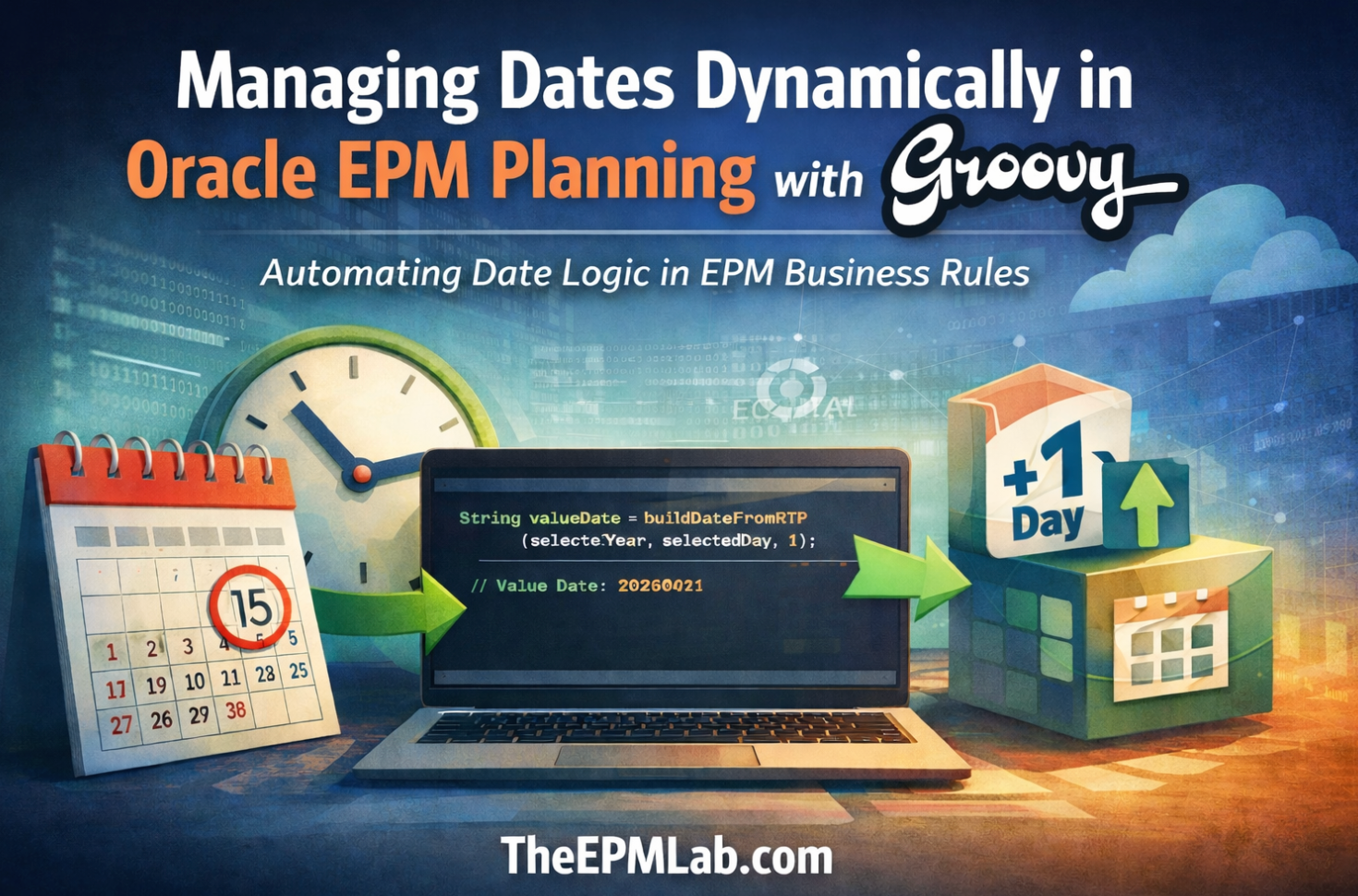
Introduction Date management is a common but often underestimated requirement in EPM Planning applications. Whether it’s driving new dates, controlling forecast cutoffs, or dynamically setting substitution variables, finance users expect the system to “just know” the right date—based on form inputs, system time, or business logic. With the introduction of Groovy in Planning business rules,…

October 6, 2025

Introduction Oracle EPM Cloud is updating its Groovy scripting engine to a newer, more secure version in January 2026. This change is not just a background update — it directly affects how Groovy-based business rules and templates run across EPM modules. If your applications rely heavily on Groovy (as most advanced Planning and FreeForm implementations…

July 19, 2023

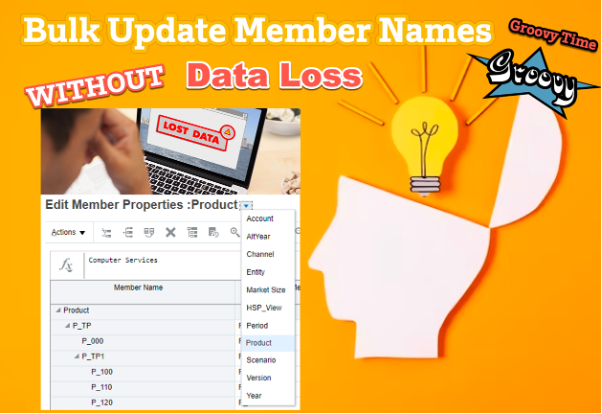
  Updating dimension member properties is a common practice in an EPM Planning/Financial Close system. This includes updating alias, member formulas, aggregation operator, etc. The traditional way is to load an updated dimension file to the system.   However, bulk uploading dimension member names is always a tricky task. Especially in the on-premises Hyperion Planning…

August 20, 2022

In an ASO reporting cube, it is important to properly clear data before pushing or copying data. ASO does not work as a BSO cube which has the block concept. In a BSO cube, copying a #missing value is common. But in an ASO cube, it will do nothing when it comes to copying the…

May 5, 2022

Groovy business rules give us the flexibility to customize the job log messages. Not only just seeing whether the job ran successfully or failed, but it can also tell a lot more.   For a quick example, I am running a dummy business rule and the job log displays the duration of the rule and…

April 3, 2022

  The attribute dimension is a special dimension that is associated with a business dimension. It is useful and powerful for filtering dimension members, processing specific calculations, and doing reporting. Attributes group data through alternative means as opposed to utilizing the existing dimensional rollups.   For a more detailed attribute introduction, check the following previous…

September 30, 2019

  The recent EPM monthly updates brought a few great REST API enhancements. With new classes added to the Groovy library, it is now possible to interact with external web recourses. This surely creates tons of potentials for EPM planning solutions.   Recent Patches Firstly, let’s take a step back and see what exactly got…