






Author: Jun

April 4, 2026

Introduction Oracle EPM Cloud gives practitioners a choice that is easy to overlook: standard Planning applications, with their familiar required dimensions and prebuilt module logic, or FreeForm, a fundamentally different application type that removes those dimensional constraints entirely. When FreeForm was first introduced, it was often described simply as ‘Essbase in the cloud with a…

April 3, 2026

Introduction Welcome back to the Groovy Lab. In this post we are going one level deeper into the Groovy API, specifically into the metadata layer. If you have read the previous posts in the Groovy Lab series, you are already comfortable with orchestration patterns, substitution variable reads, calc script execution, and data interaction techniques.  …

April 2, 2026

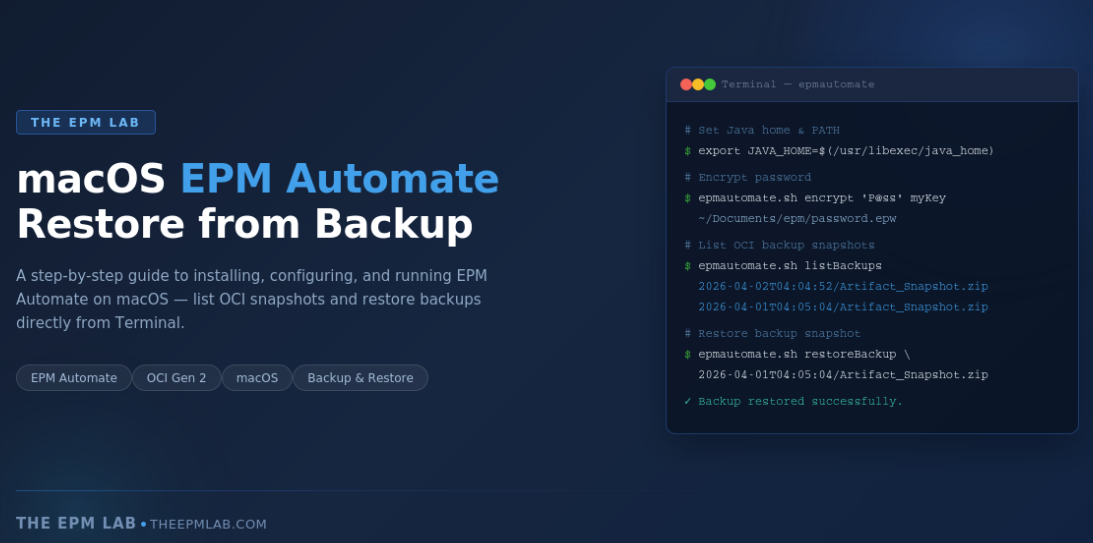
Introduction If you manage Oracle EPM Planning environments on OCI (Gen 2), knowing how to restore a backup is one of the most critical administrative skills you can have. Whether you are recovering from a bad data load, rolling back a configuration change, or simply archiving a snapshot before a major release, the restore workflow…

April 1, 2026

Introduction Welcome to Part 2 of the Groovy Rules Ideas series. In Part 1, we focused on orchestration and automation, patterns for reading substitution variables, running business rules, executing calc scripts, triggering DM loads, polling for job status, and running Data Maps. Groovy Lab –  Groovy Rules Ideas – part 1 Groovy Lab – Managing…

March 30, 2026

Introduction Welcome back to the Groovy Lab. In previous blog posts, we covered Groovy fundamentals, managing dates, the Groovy engine upgrade and validator deep dive, ASO data clear techniques, and more. This time, we are taking it further with a curated collection of Groovy rule ideas that address real-world use cases in Oracle EPM Planning….

March 29, 2026

1. Introduction In my previous posts, Smart View for Google Workspace and Smart View for Google Workspace – Part 2, I covered the initial setup, installation from the Google Workspace Marketplace, and how to get started with Oracle Smart View in Google Sheets. Since then, I’ve spent more time working with the extension and have…

March 27, 2026

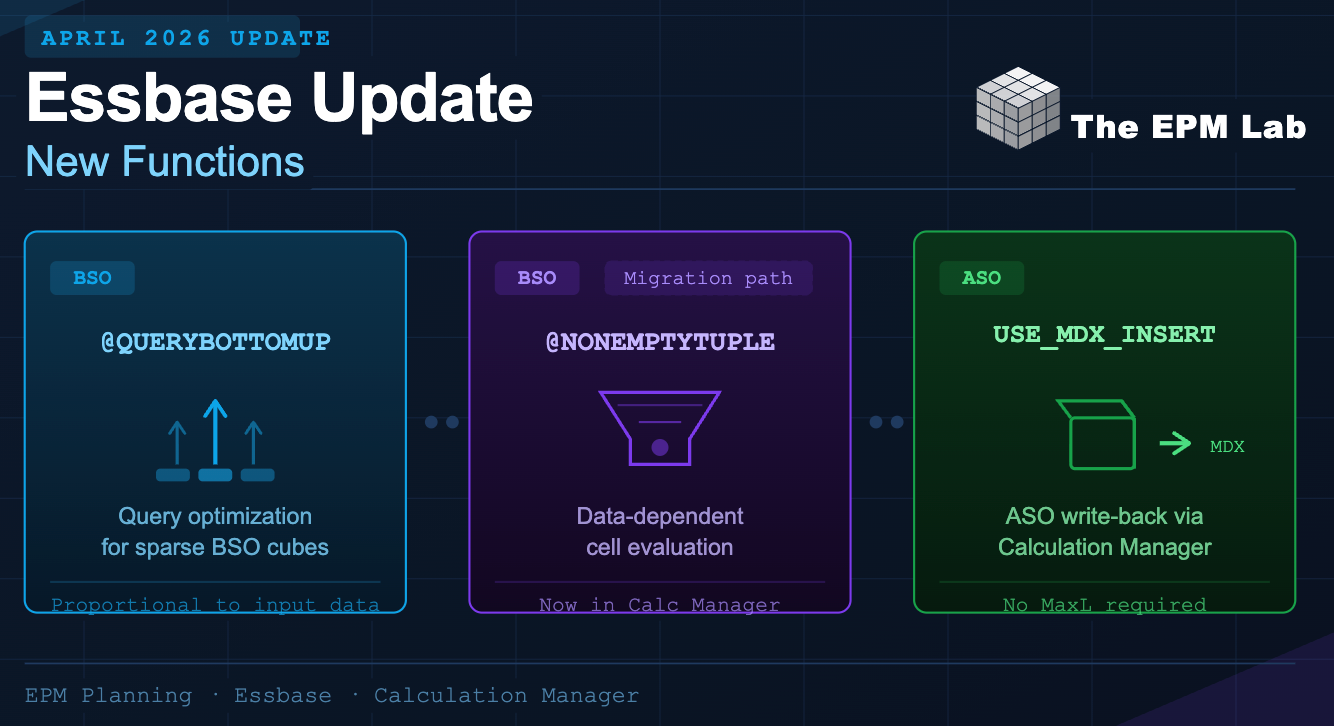
After a brief hiatus, Oracle EPM monthly updates return in April 2026. This patch brings a focused set of Essbase-level improvements and for planning developers who write Business Rules, this one is worth paying attention to. The April 2026 update delivers two BSO calculation functions to the Calculation Manager, plus a new ASO MDX capability….

February 9, 2026

Oracle EPM Planning is a mature and highly capable platform. However, in real-world implementations, challenges around performance, usability, and long-term maintainability rarely stem from missing functionality. More often, they can be traced back to design and build decisions made early in the project lifecycle. This post focuses on practical, field-tested guidance for designing and building…

February 6, 2026

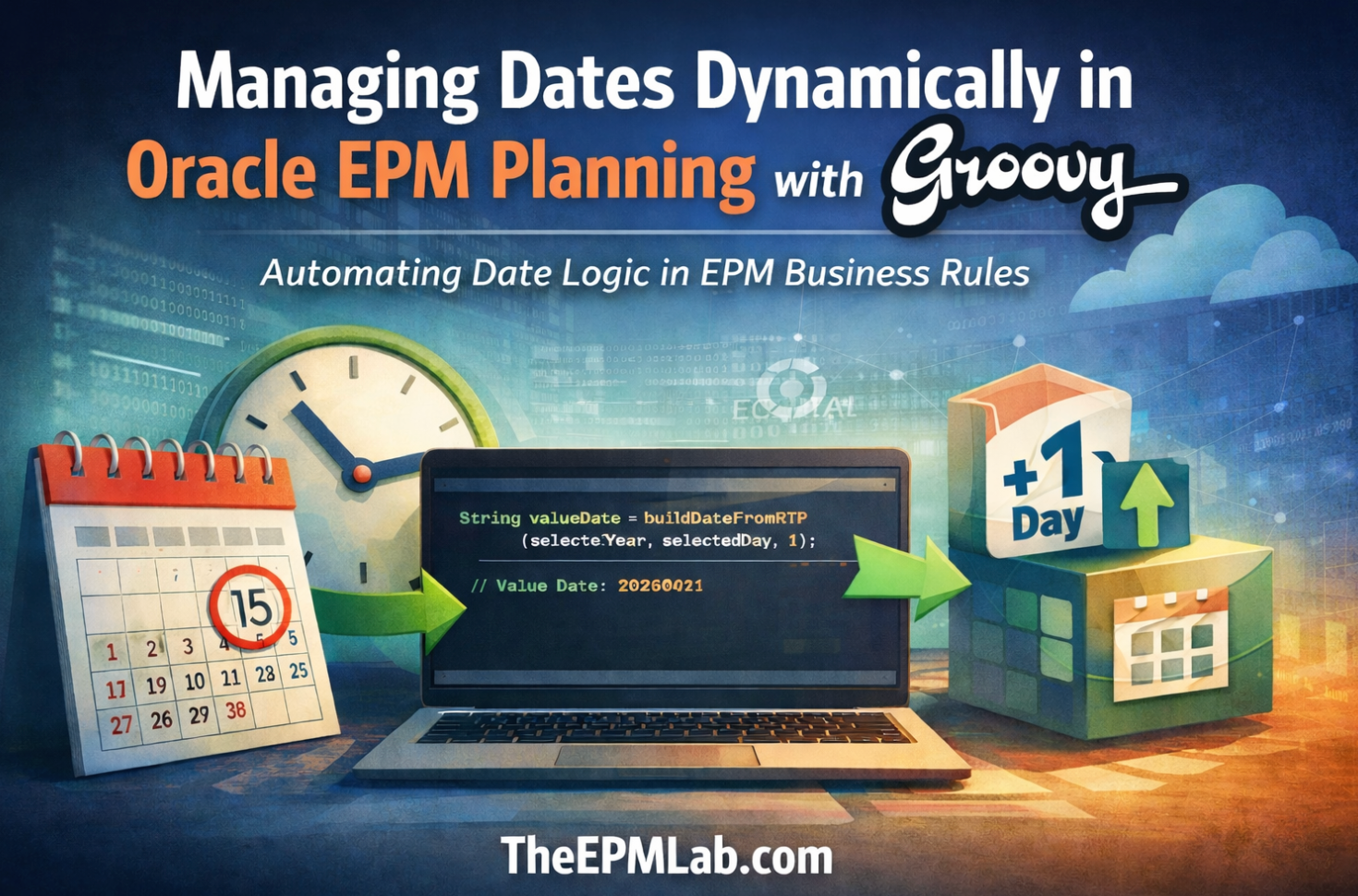
Introduction Date management is a common but often underestimated requirement in EPM Planning applications. Whether it’s driving new dates, controlling forecast cutoffs, or dynamically setting substitution variables, finance users expect the system to “just know” the right date—based on form inputs, system time, or business logic. With the introduction of Groovy in Planning business rules,…

January 30, 2026

Introduction Oracle has been steadily embedding AI and ML capabilities across the Cloud EPM suite. AI narrative reporting is not new. Since it got released, we start to see a very concrete and practical application of generative AI in Narrative Reporting. This post focuses on automated management report narratives, driven directly off report data and…